Ginkgo Biloba for Memory: The Science of Blood Flow, Focus and Recall
Misplacing your keys, blanking on a familiar name, or feeling your thoughts move a little slower than they used to — after age 60, these moments are common, and they have a lot to do with one quiet factor: how well blood reaches your brain. That is exactly why one of the oldest tree species on Earth has become one of the most studied botanicals in cognitive science: Ginkgo Biloba. Unlike a quick stimulant, Ginkgo is researched for something more fundamental — supporting circulation and protecting neurons so your brain has what it needs to think and remember. In this article we break down exactly how it works, what the clinical research shows, and why it earns its place in the Memo Pezil formula.
Key Takeaways
- Ginkgo Biloba is one of the most extensively studied botanicals for memory and cerebral blood flow in adults 60+.
- Its benefits are linked to two unique compound families — flavonoid glycosides and terpene lactones — that support circulation and antioxidant defense.
- The standardized extract studied most in clinical trials is known as EGb 761.
- Benefits are cumulative — most research points to results after roughly 4–12 weeks of daily use, not a single dose.
What Is Ginkgo Biloba?
Ginkgo Biloba is a "living fossil" — the last surviving species of a tree family that has existed for more than 200 million years. Its distinctive fan-shaped leaves have been used in traditional East Asian wellness practices for centuries. What moved Ginkgo from ancient remedy to modern laboratory is its rich chemistry: the leaves contain flavonoid glycosides and terpene lactones (including ginkgolides and bilobalide). Researchers became interested because these compounds appear to influence two things the aging brain cares about most — blood flow and protection from oxidative stress [1].
The Real Mechanism: Cerebral Blood Flow and Antioxidant Defense
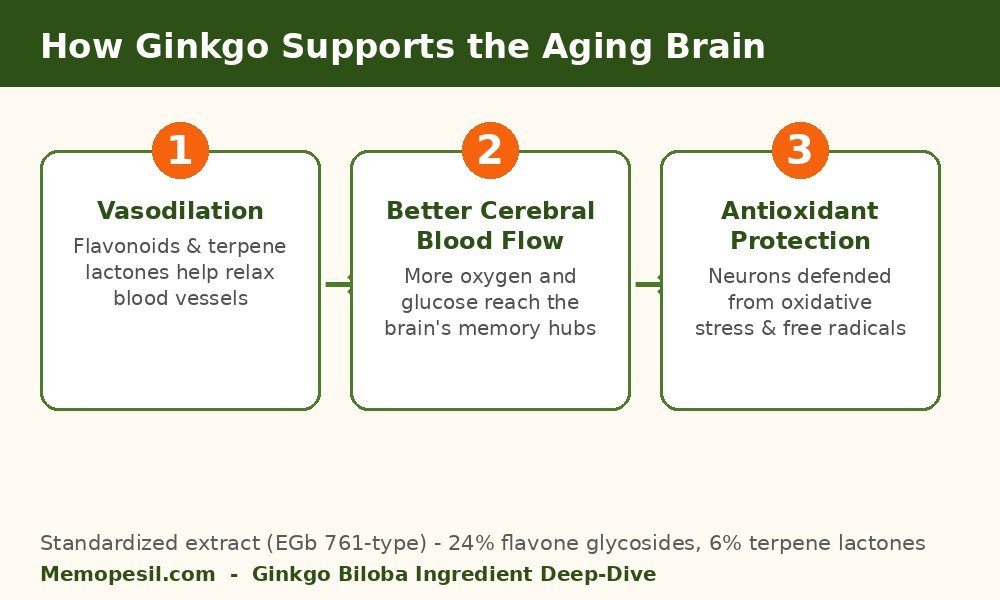
To understand why Ginkgo is different, you need to understand a simple truth about the brain: it is an extraordinarily hungry organ. Though it makes up only about 2% of body weight, it consumes roughly 20% of the body's oxygen and glucose. All of that has to arrive through a network of tiny blood vessels — and as we age, circulation to brain tissue can become less efficient.
Here is where Ginkgo's chemistry matters. Its flavonoids and terpene lactones are associated with vasodilation — helping blood vessels relax — and with improved microcirculation. At the same time, those same compounds act as powerful antioxidants, helping neutralize the free radicals that contribute to cognitive aging [1][6]. In other words, Ginkgo works on the brain's support system rather than acting as a direct stimulant.
Why Blood Flow Matters for Memory After 60
Memory is not stored in one place — it is encoded and retrieved through networks of neurons, especially in the hippocampus, the brain's primary memory hub. Those neurons depend on a steady supply of oxygen and glucose to do their work. When circulation is healthy, the brain can encode new information and recall old memories more efficiently. This is precisely the kind of support that becomes more valuable as the brain ages, which is why blood-flow-supporting ingredients have become such a focus in cognitive science [1][2].
What the Clinical Research Actually Shows
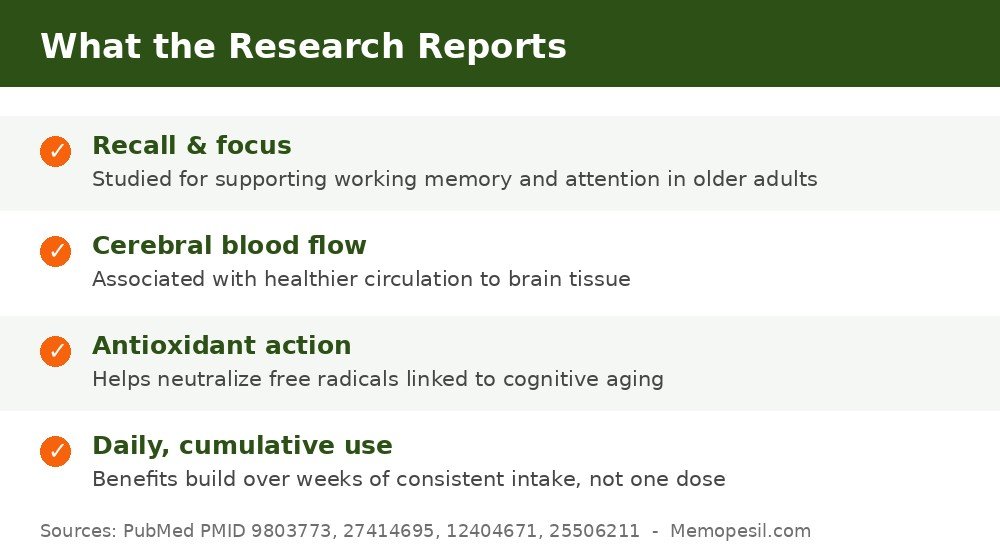
It is easy to find bold claims online, so let's focus on what controlled human studies have reported. Ginkgo is unusual among supplement ingredients because it has been examined in numerous randomized, placebo-controlled trials over several decades — most using the standardized EGb 761 extract.
One frequently cited study by Mix and Crews (2002) ran a 6-week, double-blind, placebo-controlled trial in 262 cognitively healthy adults aged 60 and over. The group taking standardized Ginkgo extract showed improvements on objective memory measures and were more likely to rate their own recall as improved versus placebo [3]. Other work has examined Ginkgo across a wider range of populations:
| Study | Population | What It Reported |
|---|---|---|
| Field & Vadnal, 1998 | Review of Ginkgo & memory | Concluded Ginkgo extract shows a probable therapeutic benefit and is widely used to support memory disorders [1]. |
| Itil et al., 1998 | Older adults with dementia | Found Ginkgo (EGb) produced measurable, "cognitive activator" effects on brain electrical activity (QEEG) [2]. |
| Mix & Crews, 2002 | Cognitively intact adults 60+ | Reported improved memory measures after 6 weeks of standardized extract versus placebo [3]. |
| Gauthier & Schlaefke, 2014 | Meta-analysis of RCTs | Pooled analysis found EGb 761 improved cognition and daily function versus placebo [6]. |
Expert Insight: The Extract Matters as Much as the Herb
A pattern repeats across the strongest Ginkgo trials: they used a standardized extract — typically 24% flavone glycosides and 6% terpene lactones, the profile known as EGb 761. Raw or poorly standardized Ginkgo can vary wildly in potency. This is why a quality formula doesn't just list "Ginkgo" on the label — the standardization, dose, and daily consistency are what the research actually supports [3][6].
How Ginkgo Compares to Other Nootropics
Ginkgo is rarely used in isolation, and for good reason — it targets a different mechanism than most other brain ingredients. Where Bacopa Monnieri is studied largely for supporting acetylcholine and recall, and Lion's Mane is linked to nerve growth factor and neuron repair, Ginkgo is the ingredient most closely associated with healthy blood flow and antioxidant defense. This is why thoughtful formulas combine them: each one supports cognition through a complementary pathway rather than overlapping.
Beyond Memory: Focus, Mood and Mental Energy
Memory is the headline, but research has also explored Ginkgo for related areas of mental performance — including attention, processing speed and feelings of mental clarity [3][5]. Because circulation, focus and emotional balance are deeply connected, supporting the brain's blood supply often helps several of these areas at once, which is why Ginkgo is valued for everyday mental sharpness, not just recall.
What to Expect Week by Week
- Weeks 1–2: No dramatic changes for most people — Ginkgo is building up, not spiking like caffeine.
- Weeks 3–6: Many users and study participants begin noticing steadier focus and easier recall.
- Weeks 8–12: The window where most clinical benefits on cognition were measured with consistent daily use [3][6].
Is Ginkgo Biloba Safe?
Ginkgo has been used for decades and is generally well tolerated in research settings, where reported side effects have typically been mild (such as minor headache or digestive discomfort). One important note: Ginkgo may have a mild blood-thinning effect, so it is especially important to talk with your doctor before starting if you take anticoagulant or antiplatelet medication, have a bleeding disorder, or have surgery scheduled. As with any supplement, Ginkgo is a complement to a healthy lifestyle, not a replacement for medical care.
Ginkgo Biloba and Memo Pezil
As one of the featured ingredients in Memo Pezil, Ginkgo Biloba contributes something few other compounds offer: support for the brain's circulation and antioxidant defenses. Working alongside Bacopa Monnieri, Lion's Mane, L-Theanine and the rest of the formula, it helps round out a comprehensive, multi-pathway approach to memory, focus and long-term cognitive vitality for adults 60 and over. You can see the full breakdown on our ingredients page, or learn more about the science on the how it works page.
Ready to Support Your Memory Naturally?
Discover how standardized Ginkgo Biloba and other carefully selected nootropics in Memo Pezil may help support focus, memory and cognitive wellness — backed by science, made for adults 60+.
ORDER MemoPezil NOWReferences and Sources:
- [1] Field, B. H., & Vadnal, R. (1998). Ginkgo biloba and Memory: An Overview. Nutritional Neuroscience, 1(4), 255–267. PMID: 27414695.
- [2] Itil, T. M., Eralp, E., Ahmed, I., Kunitz, A., & Itil, K. Z. (1998). The pharmacological effects of ginkgo biloba, a plant extract, on the brain of dementia patients in comparison with tacrine. Psychopharmacology Bulletin, 34(3), 391–397. PMID: 9803773.
- [3] Mix, J. A., & Crews, W. D. Jr. (2002). A double-blind, placebo-controlled, randomized trial of Ginkgo biloba extract EGb 761 in cognitively intact older adults. Human Psychopharmacology, 17(6), 267–277. PMID: 12404671.
- [4] Le Bars, P. L., et al. (1997). A placebo-controlled, double-blind, randomized trial of an extract of Ginkgo biloba for dementia (North American EGb Study Group). JAMA, 278(16), 1327–1332. PMID: 9343463.
- [5] Herrschaft, H., et al. (2012). Ginkgo biloba extract EGb 761 in dementia with neuropsychiatric features: a randomised, placebo-controlled trial (240 mg/day). Journal of Psychiatric Research, 46(6), 716–723. PMID: 22459264.
- [6] Gauthier, S., & Schlaefke, S. (2014). Efficacy and tolerability of Ginkgo biloba extract EGb 761 in dementia: a systematic review and meta-analysis of randomized placebo-controlled trials. Clinical Interventions in Aging, 9, 2065–2077. PMID: 25506211.